


Cloud computing continues to transform how organizations build, deploy, and scale digital services. Adoption is no longer experimental but foundational across sectors. From healthcare systems migrating patient data to private clouds, to global retailers running their AI‑driven recommendation engines on public clouds, even defense agencies now rely on hybrid setups, and cloud strategies are deeply embedded in operations. Dive in to explore the latest statistics shaping cloud adoption today.
Editor’s Choice
- $723.4 billion, forecasted global end‑user spending on public cloud services in 2025, up from $595.7 billion in 2024.
- 94% of enterprise organizations now run at least some workloads in the cloud.
- Roughly 29–33% of organizations anticipate spending over $12 million on public cloud annually by 2025, depending on sector and cloud maturity.
- 71% of organizations expect their cloud spend to increase this year.
- 21% year‑on‑year growth in global cloud infrastructure spend in Q1 2025, reaching approximately $90.9 billion.
- $94 billion total enterprise spending on cloud infrastructure in Q1 2025.
- 87% of enterprises are expected to use hybrid cloud by the end of 2025.
Recent Developments
- More organizations are adopting digital sovereignty strategies, with Gartner projecting that over half of global multinationals will do so by 2029, up from under 10% now.
- Hyperscalers, such as AWS, Azure, and Google, are accelerating infrastructure investments, with U.S. hyperscalers alone set to spend nearly $1.15 trillion by 2027 on data, servers, and facilities.
- AI workloads are driving growth, with GenAI‑specific services growing between 140% and 160% in Q1 2025.
Biggest Cloud Challenges Faced by Organizations
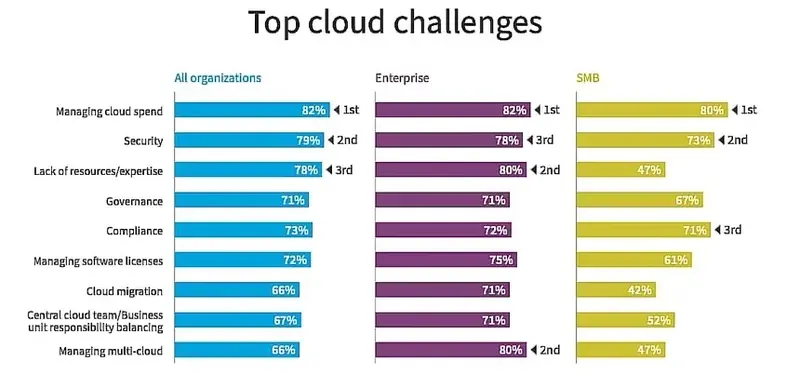
- Managing cloud spend is the top challenge, affecting 82% of enterprises, 80% of SMBs, and 82% overall.
- Security concerns impact 79% of organizations and 73% of SMBs, making it a critical risk factor.
- Lack of resources or expertise affects 78% overall, hitting 80% of enterprises but only 47% of SMBs.
- Governance issues challenge 71% of enterprises and 67% of SMBs, reflecting growing complexity in oversight.
- Compliance requirements are cited by 73% overall and 71% of SMBs, ranking as a top 3 concern.
- Managing software licenses creates problems for 72% of all organizations and 75% of enterprises.
- Cloud migration difficulties affect 66% overall, with 71% of enterprises and 42% of SMBs reporting issues.
- Balancing responsibilities between IT teams and business units is a concern for 67% of organizations.
- Managing multi-cloud environments is difficult for 66% overall, rising to 80% of enterprises but only 47% of SMBs.
Global Cloud Adoption Overview
- 936 billion, or approximately $912.77 billion, is a commonly cited estimate for the 2025 size of the global cloud computing market.
- Public cloud spending alone is forecast to hit $723.4 billion in 2025, up from $595.7 billion in 2024, a 21.5% increase.
- In Q1 2025, global infrastructure spending reached $90.9 billion, up 21% year-over-year.
- Combined, AWS, Microsoft, and Google accounted for 63% of total enterprise infrastructure spending in Q1 2025.
- AWS holds about 30–32% of the global IaaS/PaaS market as of early 2025.
- 50% of all data worldwide is projected to be stored in cloud systems by 2025, up from 25% in 2015.
- 100 billion connected devices are estimated for 2025, many relying on cloud backends for compute and storage.
- The cloud computing market is expected to grow to $1.614 trillion by 2030.
Market Growth and Forecasts
- The compound annual growth rate (CAGR) of cloud through 2030 is forecast to remain in double digits across most segments.
- Public cloud alone is expected to exceed $1 trillion by 2026.
- Tech services, such as AI and analytics, and hybrid strategies will drive much of that growth.
- SMBs are expected to allocate over 50% of their tech budgets to cloud in 2025.
- Cloud-related infrastructure capex, such as data centers and power systems, is set to exceed $1 trillion in the next few years.
Market Share of Top Cloud Service Providers
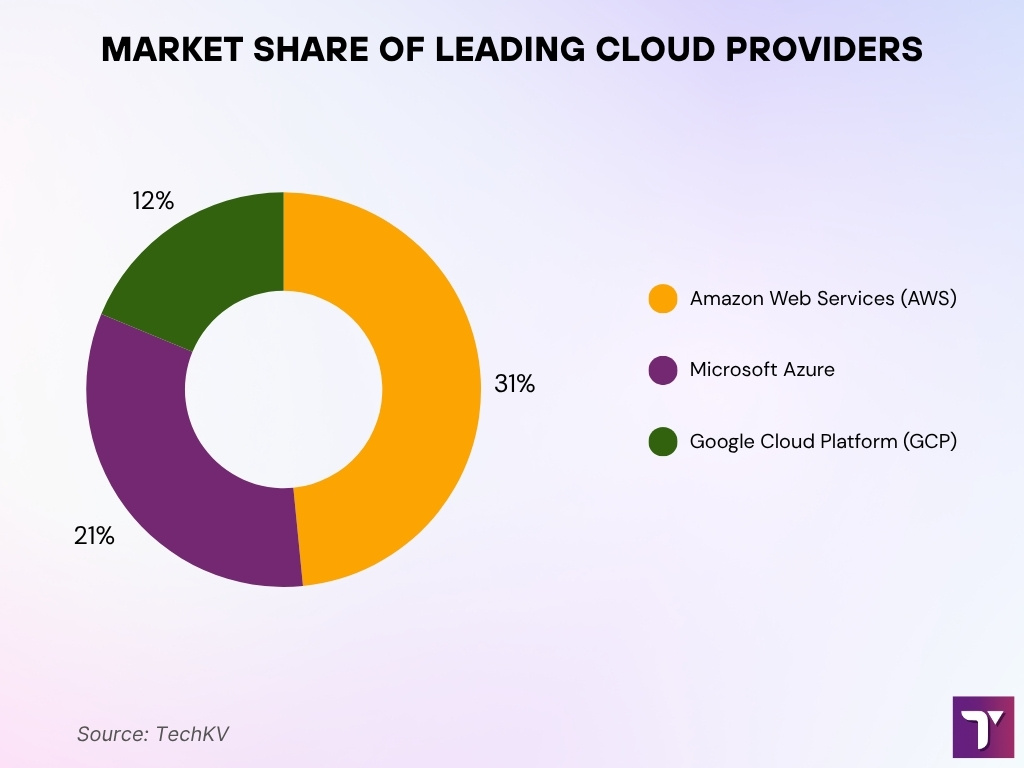
- Amazon Web Services (AWS) leads the global cloud market with a 31% share.
- Microsoft Azure follows as the second-largest provider, holding 21% of the market.
- Google Cloud Platform (GCP) ranks third, accounting for 12% of the total global market share.
Adoption Rates by Region
- North America leads with the largest public cloud revenue share, contributing approximately $248.07 billion, with the U.S. alone at around $183.57 billion in 2024.
- Asia-Pacific, especially China, India, and Southeast Asia, is one of the fastest-growing regions for cloud services.
- In China, public cloud revenue is projected to reach $121 billion by 2027.
- Europe trails North America but remains a significant market, especially with strict GDPR demands skewing toward private and hybrid models.
- Latin America and Africa show growing adoption, primarily via public cloud, though constrained by network and regulation.
- In developed markets, over 90% of organizations have some cloud presence, while in emerging markets, it’s closer to 60–80% depending on the sector.
- Countries with strict data localization rules are expanding local cloud data centers to prevent cross-border data transfer issues.
- Regions with high edge and IoT growth, such as Southeast Asia and Latin America, are seeing hybrid-cloud adoption accelerate faster than core cloud migration.
By Industry
- The banking, software/information services, and retail industries will spend an estimated $190 billion on public cloud services in 2024, representing nearly 30% of total cloud spend globally.
- In professional services and finance, SaaS accounts for 40–50% of cloud budgets, largely due to widespread use of CRM, ERP, and collaboration tools.
- Manufacturing and energy sectors see about 25% CAGR in edge‑cloud spending, largely driven by IoT deployments and real-time predictive maintenance applications.
- Over 60% of healthcare and life sciences organizations use hybrid or private cloud for sensitive workloads to ensure compliance with HIPAA and increasing data regulation requirements.
- Retail and e‑commerce increased cloud investments by 28% year-over-year to support real-time personalization and seasonal scalability during high-demand periods.
- The education sector saw a 16% growth in cloud adoption in 2024, as schools embrace cloud-based LMS, student data management, and collaboration platforms.
- Around 70% of telecommunications and media companies now run AI/ML workloads on cloud infrastructure, with projected annual spend in this category reaching $10 billion by 2025.
Key Advantages of Private Cloud Adoption in Organizations
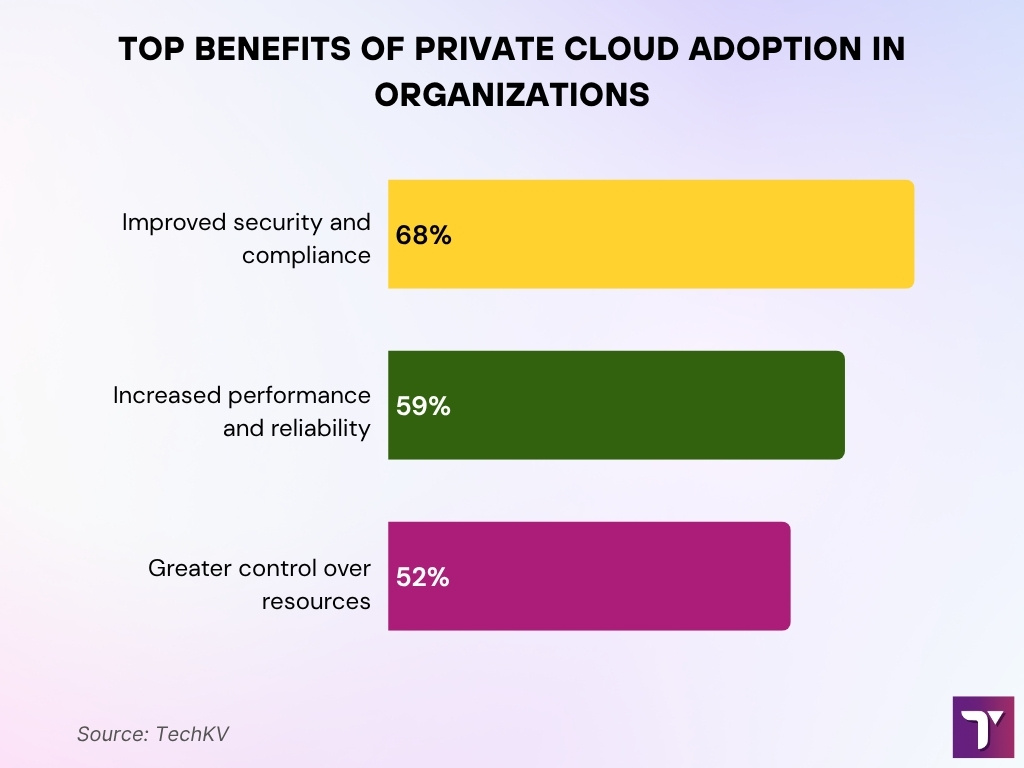
- Enhanced security and compliance are the top benefits, reported by 68% of organizations using private cloud solutions.
- Improved performance and reliability are cited by 59% of organizations as major advantages.
- Greater control over resources is valued by 52% of organizations leveraging private cloud infrastructure.
Cloud Adoption Drivers
- 81% of organizations cite scalability and elasticity as the primary reason for moving workloads to the cloud, ensuring resources can be adjusted in real-time to meet demand surges.
- 76% of IT leaders say the speed of innovation and agility offered by cloud platforms is crucial, with rapid prototyping reducing product development cycles by up to 32%.
- 68% of enterprises choose cloud services for their global reach, taking advantage of distributed datacenters to lower latency and improve user experience.
- 64% report that AI, analytics, and big data workloads are a key motivator, with over 50% of heavy data projects now running on cloud-native platforms for greater processing power.
- 73% of businesses employ cloud for disaster recovery and resilience, with cloud backup reducing downtime in outages by 39%.
- 54% of organizations cite regulatory pressures as influencing cloud decisions, with financial services and healthcare sectors especially likely to modernize for compliance or retain data privately.
- 69% emphasize the value of rich ecosystems and managed services, noting plug-and-play features have cut infrastructure setup time by 45%.
- 62% of organizations pursue multi-cloud architectures to avoid vendor lock-in, prioritizing flexibility and negotiating leverage with providers.
Strategies
- Lift-and-shift is used in over 50% of initial cloud migrations, favored for speed and lower disruption in legacy environments.
- Replatforming and refactoring are prominent for legacy modernization, with 57% of enterprises opting to replatform selected workloads and 46% undertaking refactor projects to improve scalability and agility.
- 75% of tech leaders now build all new products as cloud-native, leveraging serverless and microservices for enhanced scalability and resilience.
- By 2027, 90% of organizations are expected to implement hybrid and multicloud-first strategies for optimal flexibility, compliance, and performance.
- Phased adoption with pilot workloads is standard, with pilots cutting migration risks and setting benchmarks for success in over 68% of enterprise projects.
- 59% of companies now have a dedicated FinOps or cost governance team, with cloud spend optimization as an early priority.
- 68% of organizations have embedded security by design and DevSecOps practices into workflows to secure cloud applications.
- Data gravity planning drives storage and processing choices, especially in hybrid/multicloud settings where 70% of enterprises face compatibility issues between cloud providers.
- Edge-cloud strategies are emerging, with more than 36% of companies reviewing cloud carbon footprints and latency-sensitive use cases.
Public Cloud Adoption and Usage Patterns
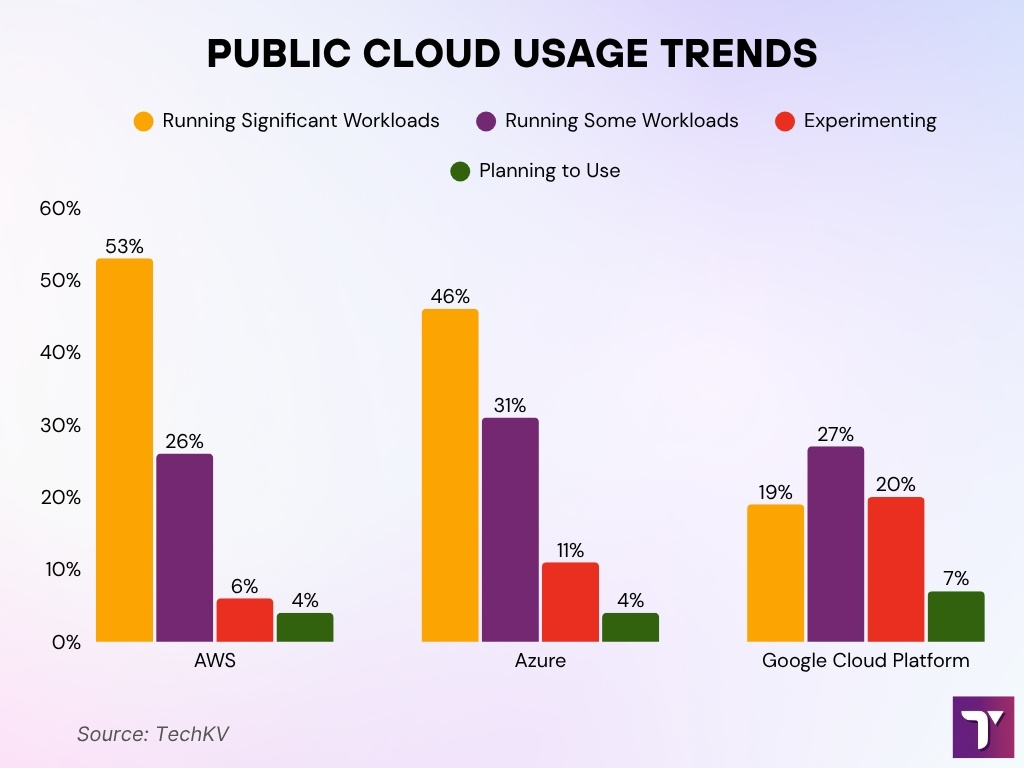
- AWS leads public cloud adoption, with 53% of organizations running significant workloads on it.
- An additional 26% use AWS for some workloads, 6% are experimenting, and 4% plan to adopt it soon.
- Microsoft Azure ranks second, with 46% running major workloads and 31% using it for partial workloads.
- Around 11% of organizations are testing Azure, while 4% plan to adopt it in the future.
- Google Cloud Platform (GCP) continues to expand, with 19% running significant workloads and 27% handling partial workloads.
- Another 20% are experimenting with GCP, and 7% are planning future adoption.
Migration Statistics
- Approximately 94% of organizations already use cloud infrastructure, storage, or software in some form.
- The global cloud migration services market is estimated at $9.85 billion in 2025 and projected to reach $35.29 billion by 2032.
- Many enterprises migrate less than 50% of workloads in early phases, often requiring 3–5 years for full migration.
- 32% of cloud budgets are wasted annually due to inefficiencies.
- 66% of organizations report wasted spending due to idle or underutilized resources.
- 49% of cloud-using organizations struggle to control cloud costs.
Service Models (IaaS, PaaS, SaaS)
- The IaaS market grew 22.5%, reaching $171.8 billion globally in 2024.
- Leading IaaS providers include AWS (37.7%), Microsoft (23.9%), and Google (9%).
- SaaS captures over 40–50% of public cloud spending.
- PaaS and IaaS each account for roughly 20% of cloud spend.
Public vs Private vs Hybrid vs Multicloud Adoption
- 39% of organizations report using hybrid cloud strategies in 2025.
- 33% leverage a multicloud approach to diversify services.
- Approximately 80% of companies incorporate more than one public cloud provider.
- 67% use public cloud, 45% use private cloud, and 55% maintain on-prem systems.
- Only 18% rely on a single cloud provider.
- 78% prefer hybrid or multicloud models to avoid lock-in.
- 87% of enterprises are forecast to use hybrid cloud by year-end.
- Gartner expects 90% hybrid adoption by 2027.
Spending and Cost Optimization
- Public cloud spending is projected at $723.4 billion in 2025.
- The full cloud market is expected to hit $1.00 trillion this year.
- Cloud security alone will exceed $19.7 billion in 2025.
- The cloud services industry is set to triple to $2.9 trillion by 2030.
- Hybrid cloud markets may reach $128.01 billion in 2025.
- 20%+ of orgs admit limited understanding of their own cloud costs.
- 32% of budgets are wasted each year due to inefficiency.
- 66% cite idle resources as a major issue.
- 49% say they cannot fully control cloud costs.
Waste and Cost Control Challenges
- 32% of organizations waste budget due to inefficiencies.
- 54% of cloud waste results from poor visibility.
- 49% struggle to contain cloud cost growth.
- 66% cite idle resources as the main source of loss.
- 75% see waste increase with usage.
- Interdepartmental chargeback is a challenge for 40–50% of companies.
Security Statistics
- 87% of enterprises use multicloud, increasing risk complexity.
- 72% rely on hybrid models.
- Cloud security software hits $7 billion in 2025.
- CSPM is forecast to grow to $15.6 billion by 2033.
- Database cloud security will grow from $10.13 billion to $50 billion by 2029.
Compliance Challenges
- Nearly 60% of cloud leaders report conflicts between global data residency rules and cross-border cloud architectures.
- Manual compliance processes increase audit costs by over 35% and delay cloud adoption timelines.
- 38% of companies now use continuous compliance monitoring, shifting away from annual or quarterly checks.
- 49% of organizations flag API mismatches with regulatory demands as a top cloud compliance risk.
- Private cloud solutions are chosen by 42% of finance and 55% of healthcare organizations for stricter data control.
- 57% of enterprises are adopting policy-as-code frameworks to automate compliance enforcement.
- Regulatory penalties for cloud non-compliance rose by 42% in the financial and healthcare sectors in the past year.
- 54% of CISOs say legal frameworks lag behind the rapid roll-out of new cloud features and services.
Workload and Application Adoption
- 58% of workloads run in public clouds, 21% in private, 21% in hybrid/on-prem.
- 35% of businesses now deploy workloads at the edge.
- GenAI workloads grew 140–160% in Q1 2025.
- Analytics, AI/ML, and pipelines dominate new cloud usage.
- ERP and mainframe systems are the slowest to migrate.
- Cloud-native apps are becoming standard.
- Media and streaming services heavily leverage cloud-native models.
- Aerospace and defense often remain on-prem for mission-critical latency.
- Cloud is the default for new workload deployment.
Frequently Asked Questions (FAQs)
~94 % of enterprises report using cloud infrastructure, storage, or software.
Public cloud spending is projected to reach about $723.4 billion in 2025.
Those three hyperscalers combined captured about 63 % of enterprise cloud infrastructure spending in Q1 2025.
Around 32% of cloud budgets are reported as wasted due to inefficiencies.
Conclusion
Cloud adoption today is no longer experimental; it’s fundamental. Organizations are embracing hybrid and multicloud strategies to balance flexibility, control, and cost. Spending surges continue, but the real challenge lies in governance, cost discipline, and securing a fragmented cloud environment. As workloads shift increasingly toward cloud-native and AI-driven designs, the winners will be those who treat cloud as a strategic platform, not a mere infrastructure substitution.
The journey through this article revealed the current state, major trends, and the pressures shaping cloud decisions. Dive deeper into each section to understand how your organization can harness these data‑driven insights.
